All projects
World2vec
World models can achieve strong control performance without faithfully capturing the dynamics of their environment, limiting their potential for mechanistic interpretability and scientific discovery. Here, we introduce world2vec to learn mechanistic world models without reward information directly from observations and actions. World2vec learns latent dynamics that faithfully reproduce the true system over long prediction horizons, with at least one order of magnitude fewer parameters than DreamerV3, TD-MPC2 and LeWM. This enables state of the art performance in controlling continuous environments from pixels and accurate system identification across a benchmark of 71 attractors, demonstrating how world models are amenable to scientific discovery.
The world2vec framework for mechanistic world modeling
A physical state evolves under actions as and is observed through a nonlinear mixing . World2vec learns an encoder that maps observations to latent states , and a latent vector field with . The model is faithful if evolving the encoded state in latent space gives the same trajectory as encoding the evolved physical state:
The condition must hold for all times and horizons . Both sides can be computed from observations and actions alone, without the physical state or the true dynamics. In training, the encoder maps a short history of frames to the initial latent (a single frame does not show velocities), Euler steps advance it under the recorded actions, and the rollout is matched to the encodings of the observed future:
For a single step, this objective matches latent velocities up to a finite difference, as in neural ODEs. Over steps, it matches the encoded displacement with the velocities accumulated along the model's own predicted trajectory, so training exposes how small one-step errors compound. We call this principle latent dynamics matching.
A regularizer prevents collapse, since a constant encoder satisfies the condition trivially. world2vec-dcl normalizes prediction scores against sampled negative embeddings (dynamics contrastive learning); world2vec-sigreg pulls embedding projections towards an isotropic Gaussian (SIGReg from LeJEPA).
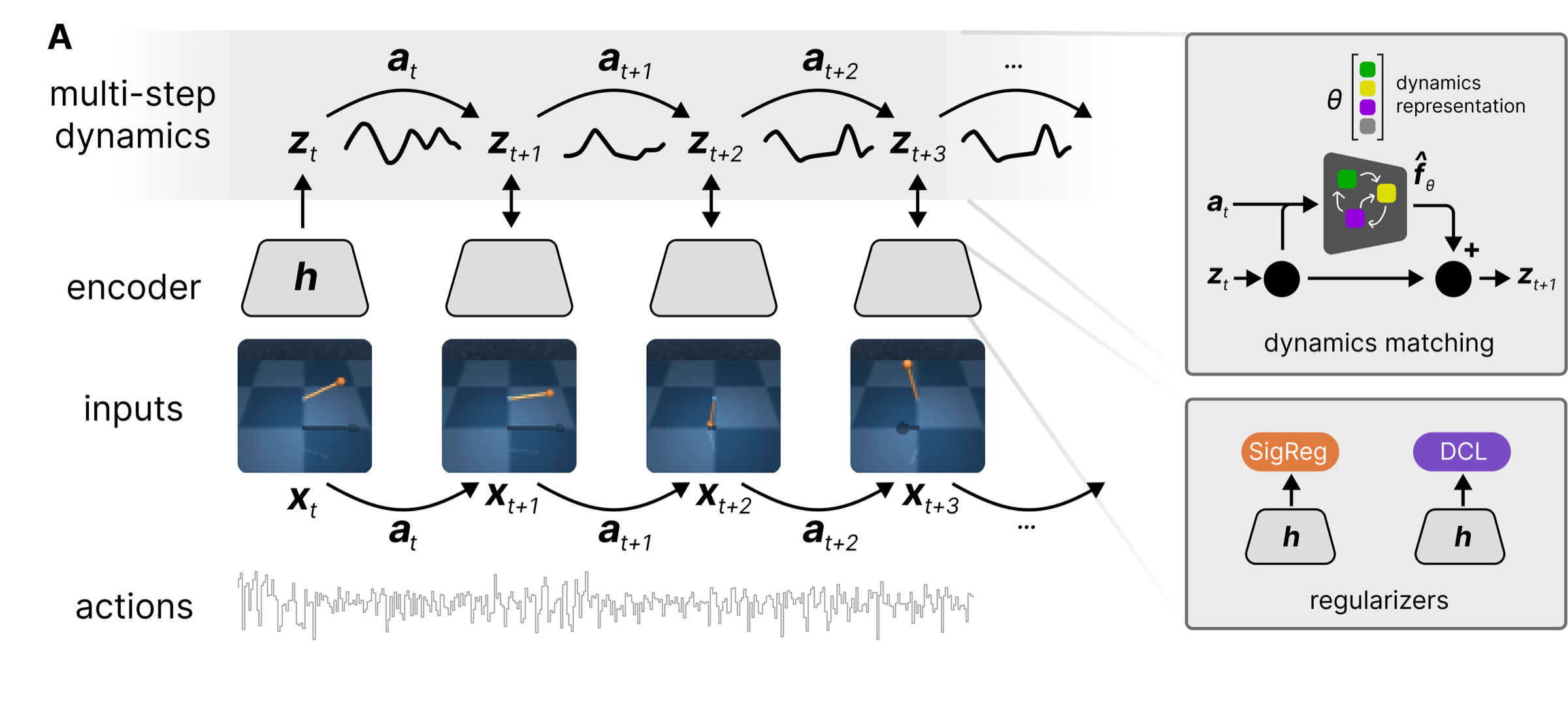
We measure the quality of the representation with consistency and the quality of the rollouts with LRC and EQA. Consistency is the R² between two independently trained encoders after an optimal affine alignment. LRC (latent rollout consistency) is the R² between latent rollouts and the encodings of the observed future. EQA (equivariance accuracy) is the top-1 retrieval accuracy of the encoded future among sampled negatives; unlike LRC, a collapsed embedding cannot score high on it. Hyperparameters are selected on validation EQA.
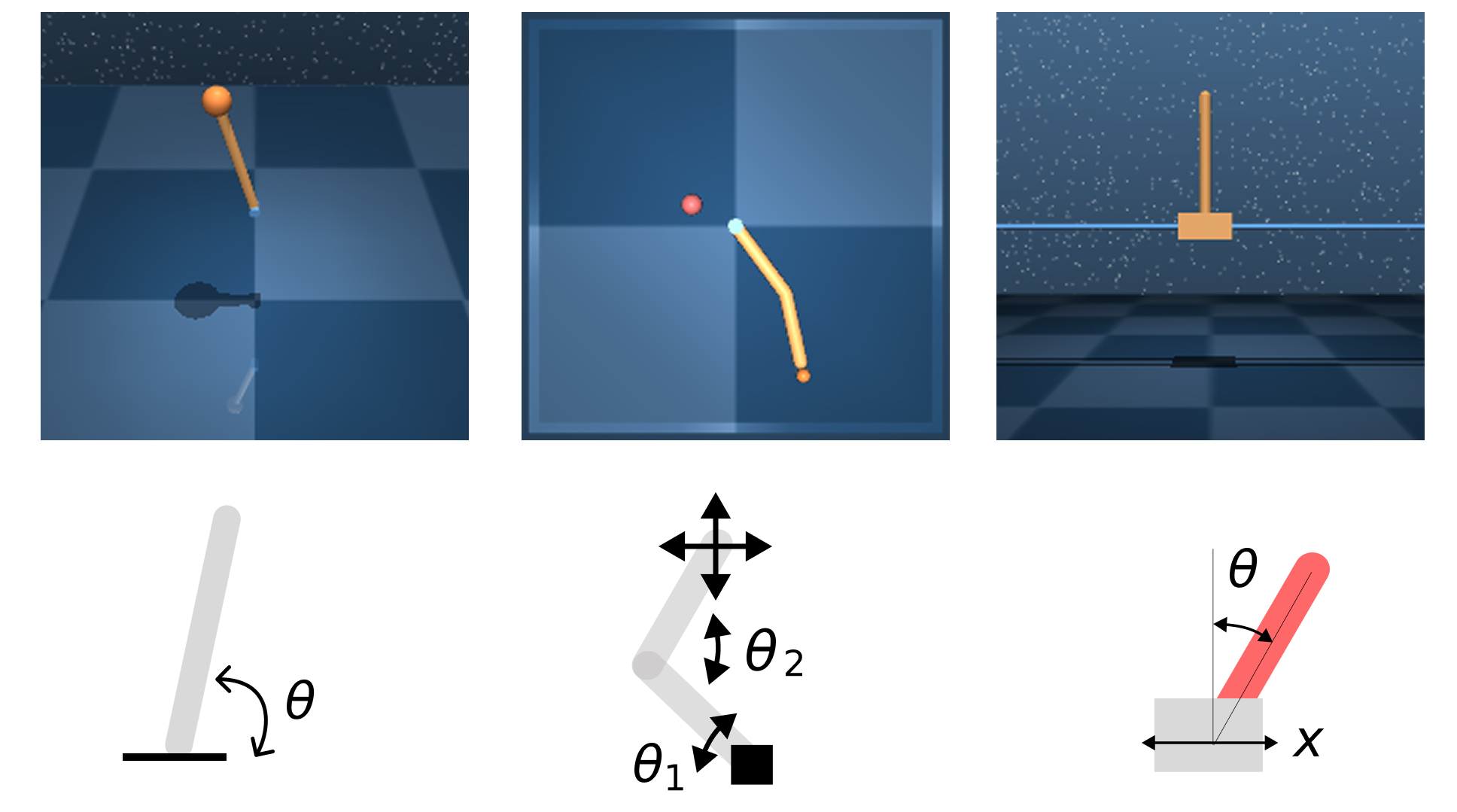
Setup: RGB frames from random policies on each environment. A small vision transformer encodes a short history of frames into a low-dimensional latent, and an MLP parameterizes the vector field; the whole model is at least an order of magnitude smaller than the baselines and trains in minutes on a single GPU. Planning uses the cross-entropy method towards an encoded goal, without a reward model or state decoder.
Planning without a reward model or state decoder
Model-predictive control on Pendulum swing-up. At every step, the planner encodes the last frames into a latent, rolls out candidate action sequences with the learned dynamics, refines them with the cross-entropy method, executes the first action of the lowest-cost plan and replans. The cost is the latent distance to the encoded upright frame.
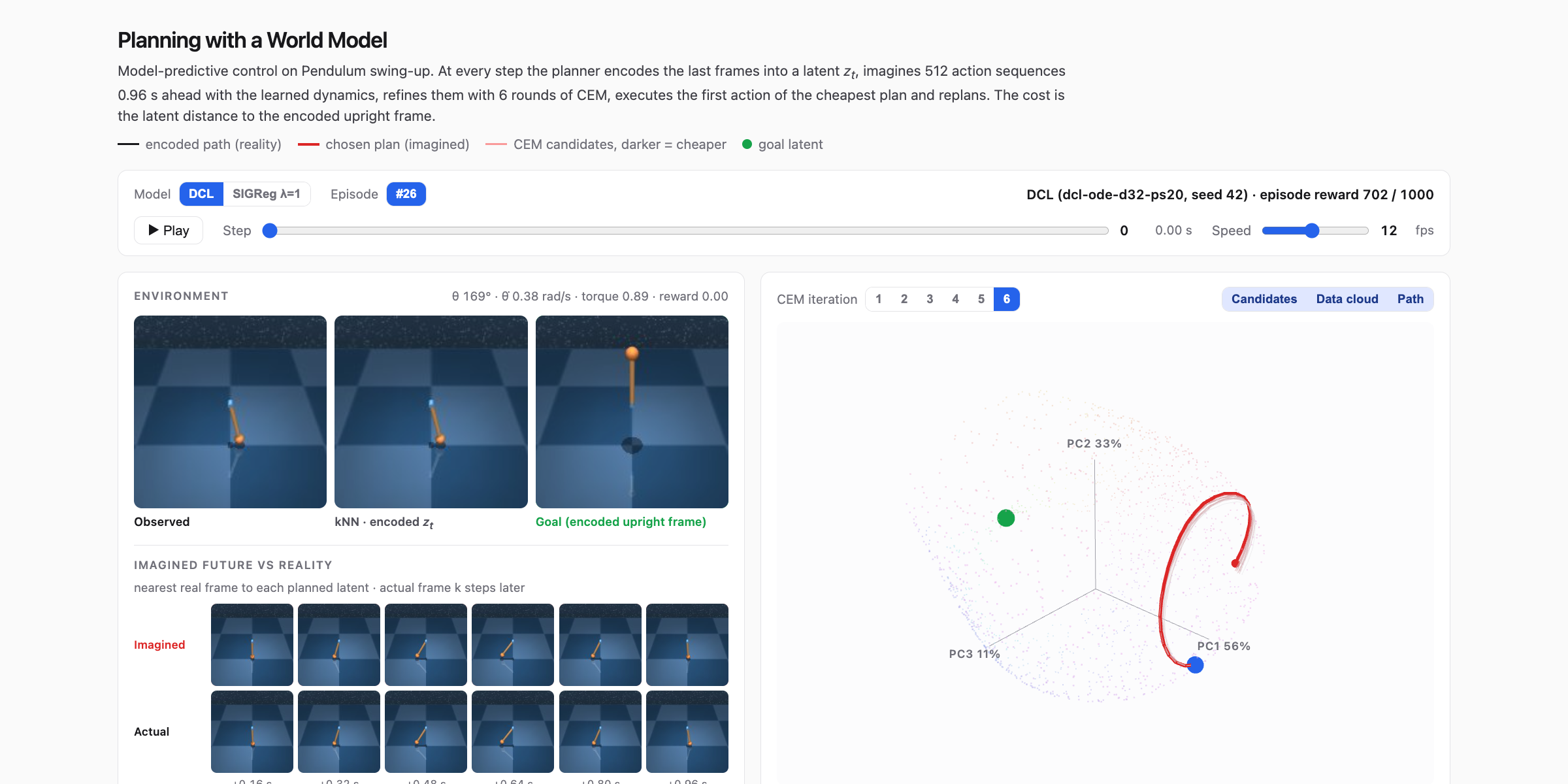
One replayed Pendulum episode, planned with world2vec-dcl and with world2vec-sigreg. Averages over seeds are in Table 1 below.
World2vec faithfully models dynamics and enables long-range predictions and control
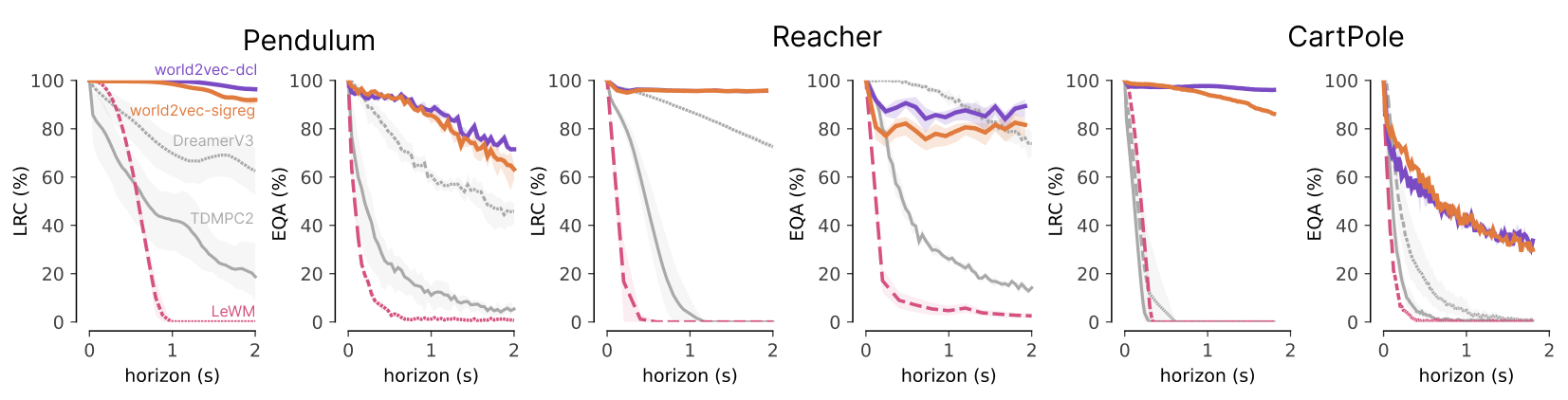
World2vec predicts faithfully over long horizons and enables model-predictive control from pixels on Pendulum and Reacher, where LeWM, the previous best JEPA-based approach, earns low rewards. Training on multistep rollouts with an Euler-integrated vector field turns one-step baselines that lose track of the system within a second into models that stay consistent with it.
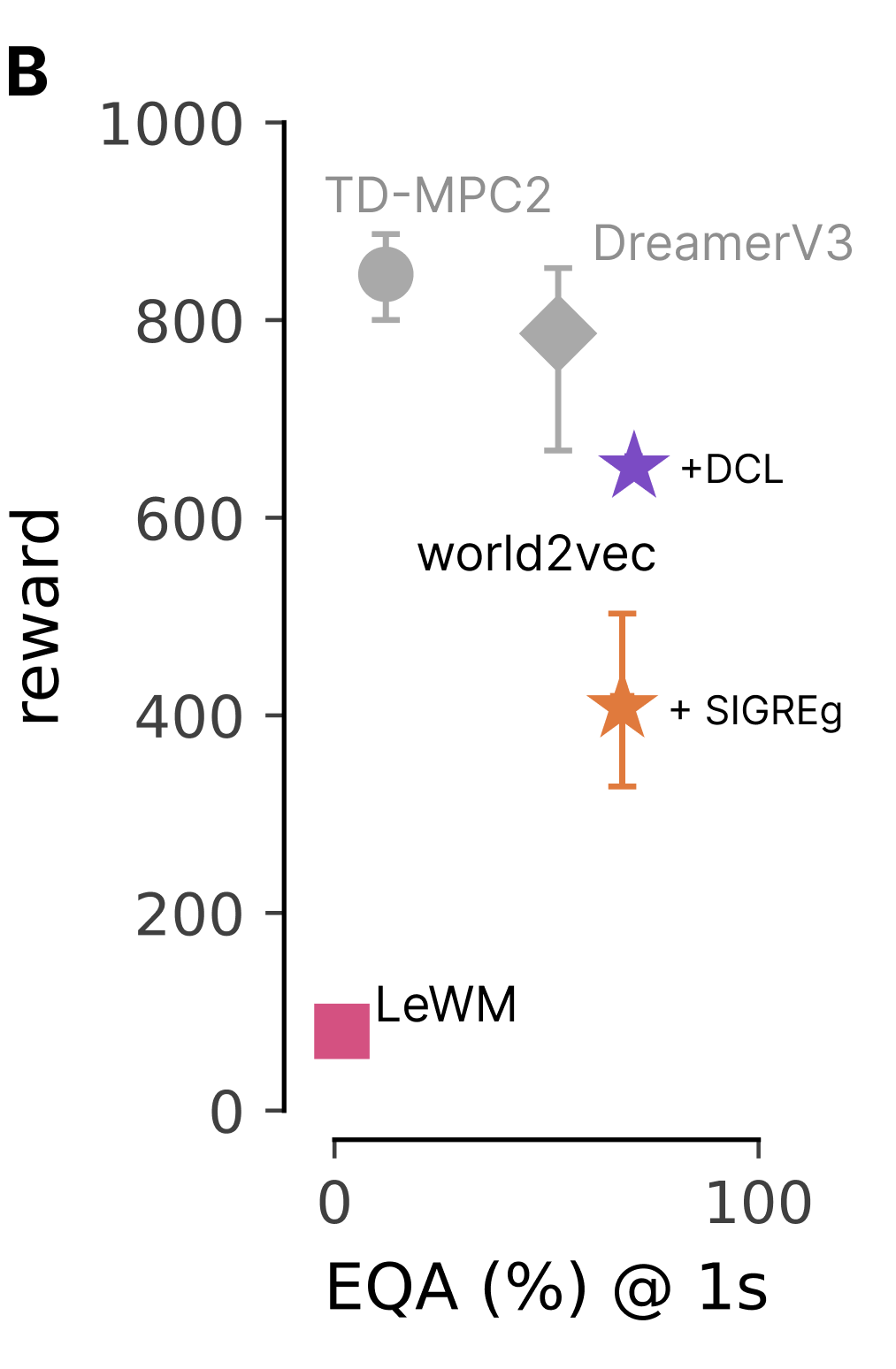
On Pendulum and Reacher, world2vec-dcl is competitive with DreamerV3 and TD-MPC2, which are trained online with reward, and far ahead of LeWM; world2vec-sigreg solves both tasks as well. CartPole remains an open challenge for reward-free world models, although it can be solved in principle from non-linearly mixed observations (Fig. 6).
DreamerV3 and TD-MPC2 reach high reward but mostly predict poorly in latent space. LeWM and world2vec are trained offline on random-policy data, the one-step baselines are LeWM-like variants within the same framework, and all models are evaluated on the same held-out test episodes. World2vec's representations are also more consistent across training runs than those of the reward-trained models.
| Reward | |||||||
|---|---|---|---|---|---|---|---|
| Method | # params | Cons. | LRC | EQA | Pendulum | Reacher | CartPole |
| DreamerV3 | 17M | 43.4 | 52.3±1.4 | 52.7±0.5 | 668±140 | 792±25 | 899±6 |
| TD-MPC2 | 5M | 87.5 | 15.5±2.4 | 12.1±0.5 | 911±2 | 744±41 | 894±9 |
| LeWM | 18M | 99.5 | 0.0±0.0 | 1.7±0.4 | 5±0 | 69±4 | 171±5 |
| Baseline (SIGReg ≈ LeWM) | 300k | 77.4 | 37.4±1.7 | 20.3±1.2 | 12±10 | 87±6 | 201±4 |
| Baseline (DCL) | 300k | 88.3 | 51.2±0.8 | 11.1±0.2 | 3±3 | 104±8 | 154±8 |
| world2vec-sigreg | 300k | 96.9 | 96.1±0.0 | 67.9±1.0 | 434±142 | 570±20 | 221±1 |
| world2vec-dcl | 300k | 95.5 | 97.7±0.1 | 70.7±0.7 | 826±0 | 895±16 | 232±5 |
| Success | |||
|---|---|---|---|
| Method | 25 steps | 200 steps | s / ep. |
| LeWM | 81.6±2.4 | 52.9±3.8 | 8.64±0.12 |
| world2vec-sigreg, 25 Hz | 85.8±1.0 | 72.4±0.2 | 2.61±0.06 |
| world2vec-dcl, 25 Hz | 86.2±1.1 | 80.2±1.6 | 2.55±0.03 |
| world2vec-sigreg, 8.3 Hz | 78.9±1.4 | 76.0±2.2 | 1.08±0.07 |
| world2vec-dcl, 8.3 Hz | 75.8±2.7 | 77.6±2.8 | 1.00±0.01 |
Because LeWM earns low rewards in this evaluation, we also test Reacher under LeWM's own goal-reaching protocol. There, world2vec matches LeWM for nearby goals, is clearly better for distant ones and plans several times faster.
A sufficiently large training horizon and latent dynamics matching are essential for latent world modeling
Compared with the one-step baseline, world2vec trains on multistep rollouts and uses a vector field integrated by Euler steps as the predictor. Both components improve the model.
Increasing the training horizon drastically improves both world2vec-dcl and world2vec-sigreg, most of all on CartPole, where one-step training fails entirely. The exact horizon matters little, as long as training goes well beyond single-step prediction.
We test the second component by replacing the Euler step with discrete transitions, , in which the MLP predicts the next latent state directly. The Euler models are better on consistency, EQA and state decoding for both variants. Discrete dynamics still reach a high LRC when the latent space is as small as the physical state.
The analysis of latent world models found that standard predictors do not capture velocity information. Modeling the latent change rather than the next latent state counteracts this failure.
Embedding geometry qualitatively reflects environment structure
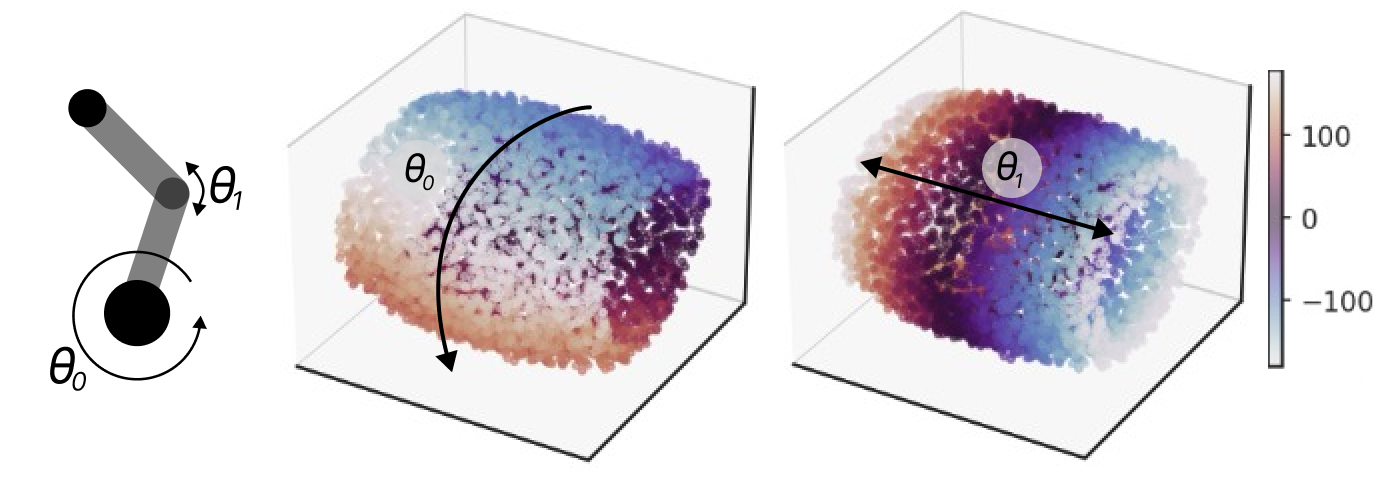
The Reacher arm is described by two angles. During data collection θ₀ performs full rotations, while θ₁ only swings left and right relative to the first arm. The embedding reflects this, with θ₀ encoded with circular boundaries and θ₁ represented linearly with open boundaries.
Continuous-time ODE parameterization allows flexible sampling
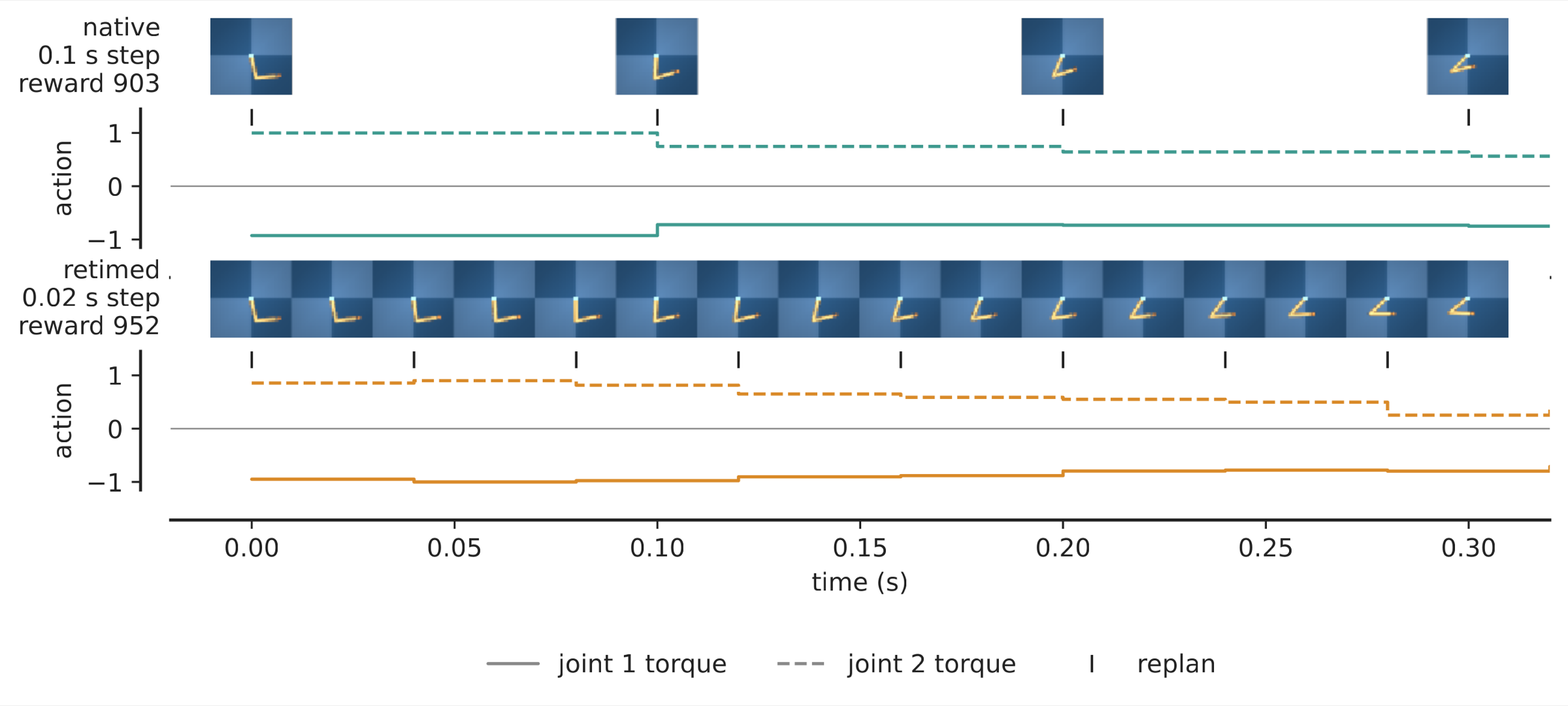
Because world2vec models the rate of change, the integration step can differ between training and planning. A Reacher model trained at one control rate also plans at a finer rate when the Euler step is reduced accordingly, without retraining, and controls the arm at least as well.
Empirical identifiability of world2vec
No reward-free world model has solved CartPole from raw observations. Following the analysis of latent world models, we replace the pixels with an increasingly non-linear mixing of the state, which makes the representation learning task harder with each layer.
For these objectives, theory predicts representations that are consistent up to an affine transformation and dynamics that are modeled faithfully over time. The state itself is not expected to be recovered linearly, since the noiseless systems lack variability along some dimensions.
As the mixing deepens, LRC and EQA decrease gradually, with world2vec-dcl degrading least, while the one-step baselines collapse as soon as the mixing has more than one layer. Reward declines only slightly, so both world2vec variants still solve CartPole from non-linearly mixed observations, whereas the baselines fail. The gap between EQA here and under pixel observations is modest, which suggests that the result can transfer to pixels with better estimation of the dynamics model.
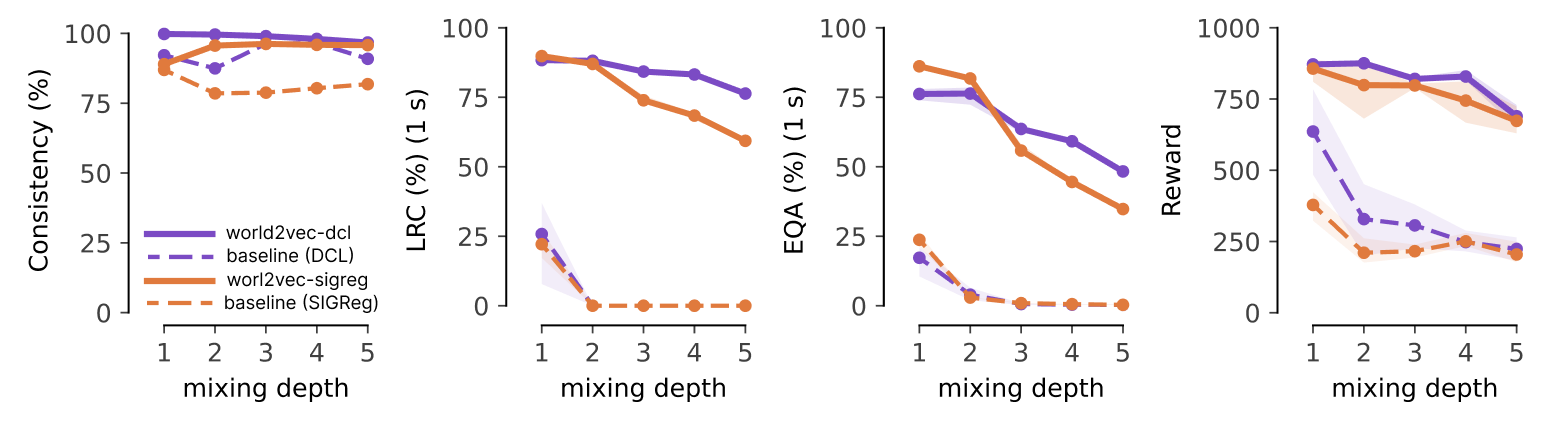
Setup: the positions and angles of the state, but not its velocities, pass through a randomly initialized, injective MLP into a higher-dimensional observation. An MLP encodes the observation history in place of the vision transformer.
Symbolic regression for understanding latent mechanisms
With a sparse polynomial library as the vector field (SINDy), world2vec-SINDy learns dynamics that can be read as equations. We evaluate it on chaotic attractors from the dysts database, with the states mixed nonlinearly into high-dimensional observations and perturbed by process noise of scale α. Training uses one-step prediction with RK4 integration and no actions.
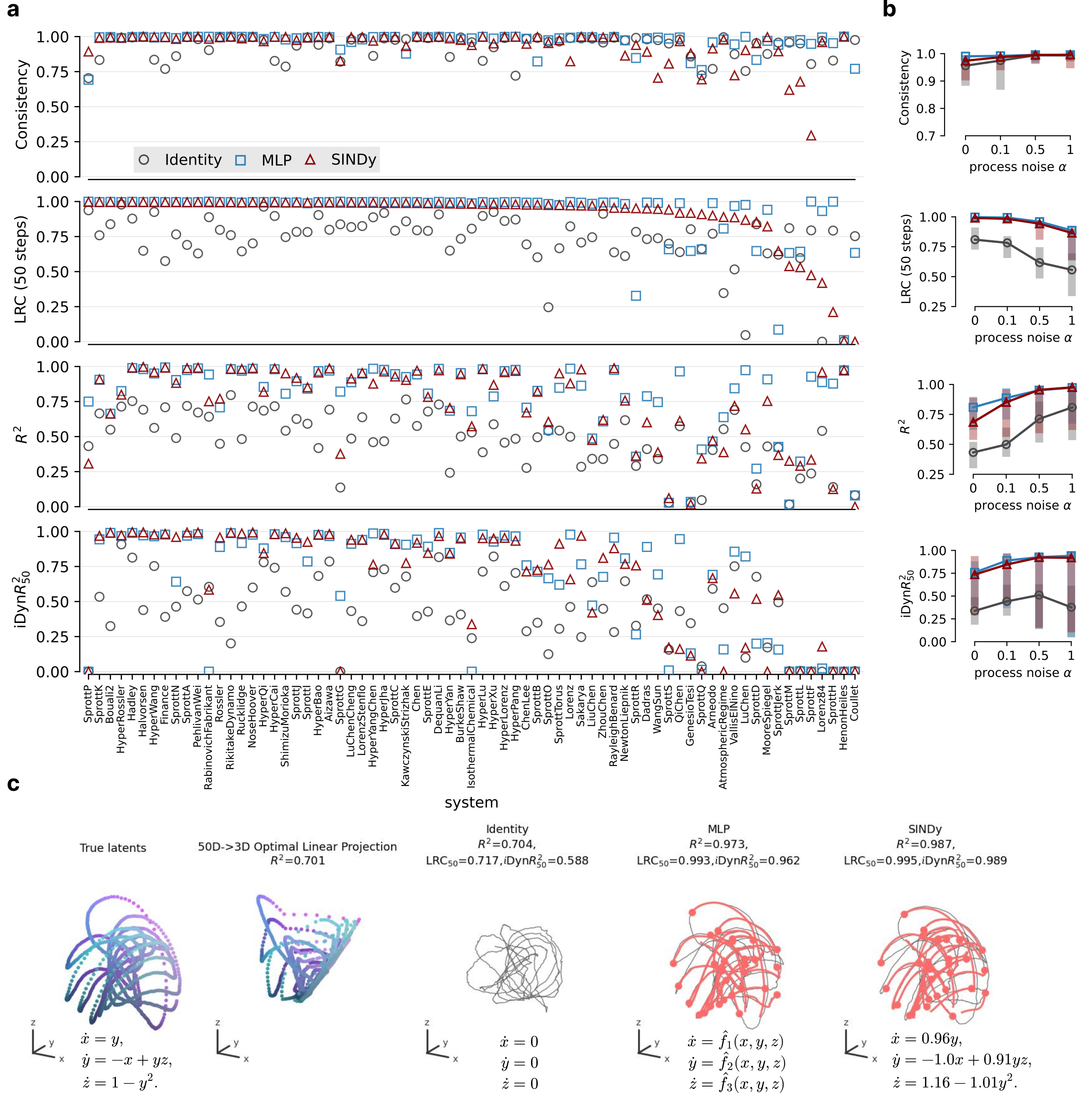
World2vec-SINDy improves substantially over an identity predictor and performs comparably to an MLP vector field, and all three give highly consistent ensembles. Process noise adds variation along every state dimension and enables linear state recovery: with more noise, affine recovery and consistency increase for all three models. Noise also caps LRC, so at high noise we judge the dynamics against the true rollouts (iDynR²), where MLP and SINDy stay far above the identity baseline.
Unlike the MLP, SINDy yields equations. For SprottA, a system whose coefficients agree well across seeds, the recovered equations approximate the true system after a least-squares alignment to the true states and removal of small coefficients. Expressing the equations in ground-truth coordinates uses the true states for this alignment; recovering them without the true states, for example with unsupervised symbolic regression, is left for future work.
Read the paper